








BY DEFENCE JOURNALIST SAHIL | T.I.N. NETWORK
“Exercise Sanyukt Manthan” के माध्यम से राष्ट्रीय सुरक्षा तैयारियों को नई मजबूती: Golden Katar Division ने मिलिट्री–सिविल फ्यूजन के तहत आयोजित किया बड़ा बहु-एजेंसी सेमिनार और टेबल टॉप एक्सरसाइज
मिलिट्री–सिविल फ्यूजन पहल के तहत सेना और नागरिक एजेंसियों का बड़ा संयुक्त मंच
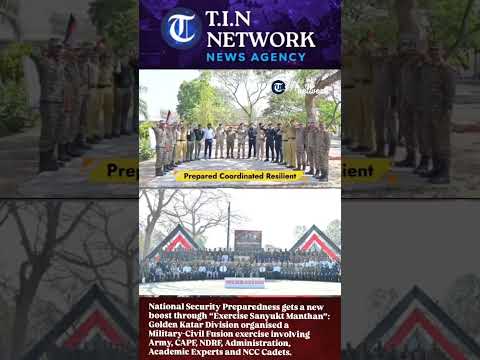
भारत की राष्ट्रीय सुरक्षा और आपदा प्रबंधन तैयारियों को मजबूत करने के उद्देश्य से भारतीय सेना की Golden Katar Division ने “Exercise Sanyukt Manthan” नामक एक महत्वपूर्ण सेमिनार और टेबल टॉप एक्सरसाइज का आयोजन किया। यह आयोजन Military–Civil Fusion पहल के तहत किया गया, जिसका उद्देश्य सेना, केंद्रीय और राज्य एजेंसियों, शैक्षणिक संस्थानों और विषय विशेषज्ञों के बीच समन्वय को और अधिक मजबूत बनाना था। इस कार्यक्रम में Konark Corps की विभिन्न इकाइयों के साथ-साथ कई केंद्रीय और राज्य एजेंसियों के प्रतिनिधियों, विशेषज्ञों और अकादमिक जगत के विद्वानों ने भाग लिया।
आज के बदलते सुरक्षा परिदृश्य में यह समझना बेहद जरूरी हो गया है कि किसी भी संकट या आपदा से निपटने के लिए केवल सैन्य शक्ति ही पर्याप्त नहीं होती, बल्कि नागरिक प्रशासन, आपदा प्रबंधन एजेंसियों, वैज्ञानिक संस्थानों और विशेषज्ञों के बीच समन्वित कार्रवाई भी उतनी ही महत्वपूर्ण होती है। इसी उद्देश्य से इस मंच का निर्माण किया गया ताकि सभी संबंधित संस्थाएं एक साथ बैठकर जटिल सुरक्षा चुनौतियों पर विचार-विमर्श कर सकें और भविष्य के लिए बेहतर रणनीतियां तैयार कर सकें।
सेमिनार और टेबल टॉप एक्सरसाइज के माध्यम से संकट प्रबंधन रणनीतियों पर मंथन
Exercise Sanyukt Manthan का मुख्य उद्देश्य जटिल संकट परिस्थितियों में बहु-एजेंसी समन्वय को मजबूत करना और निर्णय लेने की प्रक्रियाओं को बेहतर बनाना था। इस कार्यक्रम के तहत आयोजित सेमिनार और टेबल टॉप एक्सरसाइज में विभिन्न संभावित आपातकालीन परिस्थितियों के काल्पनिक लेकिन यथार्थपरक परिदृश्यों पर चर्चा की गई।
टेबल टॉप एक्सरसाइज एक ऐसा प्रशिक्षण मॉडल है जिसमें विशेषज्ञ और अधिकारी एक नियंत्रित वातावरण में बैठकर संभावित संकट की स्थिति में प्रतिक्रिया देने की रणनीति तैयार करते हैं। इस प्रक्रिया के दौरान यह विश्लेषण किया जाता है कि विभिन्न एजेंसियां किस प्रकार एक-दूसरे के साथ समन्वय स्थापित करते हुए संकट से प्रभावी ढंग से निपट सकती हैं।
अभ्यास के दौरान प्रतिभागियों ने आपदा प्रबंधन, आपातकालीन संसाधनों की तैनाती, त्वरित प्रतिक्रिया तंत्र, संचार नेटवर्क और प्रशासनिक समन्वय जैसे कई महत्वपूर्ण विषयों पर गहन चर्चा की। इस तरह की अभ्यास प्रक्रिया से यह सुनिश्चित किया जाता है कि वास्तविक संकट की स्थिति में सभी एजेंसियां पहले से प्रशिक्षित और तैयार हों।
CBRN खतरों से निपटने की तैयारियों पर विशेष ध्यान
Exercise Sanyukt Manthan का एक महत्वपूर्ण पहलू Chemical, Biological, Radiological and Nuclear (CBRN) खतरों से निपटने की तैयारियों पर केंद्रित था। आधुनिक सुरक्षा वातावरण में CBRN खतरे सबसे जटिल और गंभीर चुनौतियों में से एक माने जाते हैं।
ये खतरे कई प्रकार की परिस्थितियों से उत्पन्न हो सकते हैं, जैसे औद्योगिक दुर्घटनाएं, आतंकवादी हमले, रेडियोलॉजिकल रिसाव या प्राकृतिक आपदाओं के कारण खतरनाक रसायनों का फैलाव। ऐसे मामलों में प्रभावी प्रतिक्रिया देने के लिए अत्यधिक प्रशिक्षित कर्मियों, उन्नत उपकरणों और बहु-एजेंसी समन्वय की आवश्यकता होती है।
इस अभ्यास के दौरान विशेषज्ञों ने CBRN घटनाओं की पहचान, खतरे के मूल्यांकन, प्रभावित क्षेत्रों को सुरक्षित करने, लोगों को सुरक्षित स्थानों पर ले जाने और डीकंटैमिनेशन प्रक्रियाओं पर विस्तार से चर्चा की। यह भी बताया गया कि ऐसे खतरों से निपटने के लिए वैज्ञानिक संस्थानों, स्वास्थ्य सेवाओं, सुरक्षा बलों और प्रशासनिक एजेंसियों का संयुक्त प्रयास आवश्यक होता है।
शिवनेरी ब्रिगेड के CBRN स्कूल का शैक्षणिक दौरा
Exercise Sanyukt Manthan के तहत प्रतिभागियों के लिए शिवनेरी ब्रिगेड के CBRN स्कूल का एक विशेष शैक्षणिक दौरा भी आयोजित किया गया। यह संस्थान भारतीय सेना का एक महत्वपूर्ण प्रशिक्षण केंद्र है, जहां सैनिकों और विशेषज्ञों को रासायनिक, जैविक, रेडियोलॉजिकल और परमाणु खतरों से निपटने के लिए प्रशिक्षित किया जाता है।
दौरे के दौरान प्रतिभागियों को विभिन्न प्रकार के आधुनिक उपकरणों, सुरक्षा किट, डिटेक्शन सिस्टम और प्रशिक्षण प्रक्रियाओं के बारे में विस्तार से जानकारी दी गई। विशेषज्ञों ने बताया कि किसी भी CBRN घटना की स्थिति में सबसे पहले खतरे की पहचान करना, प्रभावित क्षेत्र को अलग करना और उचित सुरक्षा उपायों के साथ बचाव कार्य शुरू करना अत्यंत आवश्यक होता है।
इस दौरे से प्रतिभागियों को व्यावहारिक रूप से यह समझने का अवसर मिला कि भारतीय सेना किस प्रकार अत्यधिक जटिल और जोखिमपूर्ण परिस्थितियों में भी प्रभावी तरीके से कार्य करने की क्षमता विकसित करती है।
कंट्रोलरेट ऑफ क्वालिटी एश्योरेंस की CBRN प्रयोगशाला का दौरा
इस कार्यक्रम के अंतर्गत प्रतिभागियों को Controllerates of Quality Assurance (CQA) की CBRN प्रयोगशाला का भी दौरा कराया गया। यह प्रयोगशाला उन उपकरणों और तकनीकों की गुणवत्ता जांच और परीक्षण के लिए जानी जाती है, जो खतरनाक वातावरण में काम करने वाले सुरक्षा बलों और आपदा प्रबंधन एजेंसियों द्वारा उपयोग किए जाते हैं।
प्रयोगशाला के विशेषज्ञों ने बताया कि CBRN घटनाओं से निपटने के लिए उपयोग किए जाने वाले उपकरणों, जैसे कि डिटेक्शन सिस्टम, सुरक्षा सूट और निगरानी उपकरणों का परीक्षण अत्यंत कठोर मानकों के तहत किया जाता है ताकि यह सुनिश्चित किया जा सके कि वे वास्तविक परिस्थितियों में पूरी तरह प्रभावी साबित हों।
इस दौरे ने प्रतिभागियों को यह समझने में मदद की कि राष्ट्रीय सुरक्षा और आपदा प्रबंधन प्रणाली में वैज्ञानिक अनुसंधान और तकनीकी परीक्षण की कितनी महत्वपूर्ण भूमिका होती है।
CAPF, NDRF, भारतीय सेना और NCC कैडेट्स की सक्रिय भागीदारी
Exercise Sanyukt Manthan में विभिन्न सुरक्षा और आपदा प्रबंधन एजेंसियों की सक्रिय भागीदारी देखने को मिली। केंद्रीय सशस्त्र पुलिस बल (CAPF) के जवानों, राष्ट्रीय आपदा प्रतिक्रिया बल (NDRF) की टीमों, भारतीय सेना की क्विक रिएक्शन टीमों और राष्ट्रीय कैडेट कोर (NCC) के कैडेट्स ने इस कार्यक्रम में भाग लिया।
CAPF और NDRF जैसे बल अक्सर प्राकृतिक आपदाओं, औद्योगिक दुर्घटनाओं और बड़े सुरक्षा संकटों के दौरान सबसे पहले मौके पर पहुंचते हैं। इसलिए इस तरह के अभ्यास उनके लिए अत्यंत महत्वपूर्ण होते हैं, क्योंकि इससे उन्हें सेना के साथ मिलकर काम करने की प्रक्रिया को बेहतर ढंग से समझने का अवसर मिलता है।
वहीं NCC कैडेट्स की भागीदारी ने युवाओं में राष्ट्रीय सुरक्षा और आपदा प्रबंधन के प्रति जागरूकता बढ़ाने में महत्वपूर्ण भूमिका निभाई।
राष्ट्रीय लचीलापन और संकट प्रबंधन क्षमता को मजबूत करने की दिशा में महत्वपूर्ण कदम
Exercise Sanyukt Manthan ने यह स्पष्ट कर दिया कि आधुनिक समय में राष्ट्रीय सुरक्षा और आपदा प्रबंधन केवल एक एजेंसी की जिम्मेदारी नहीं है। इसके लिए सेना, प्रशासन, वैज्ञानिक संस्थानों, आपदा प्रबंधन एजेंसियों और नागरिक समाज के बीच मजबूत सहयोग आवश्यक है।
Military–Civil Fusion पहल इसी सहयोग को मजबूत करने का एक महत्वपूर्ण माध्यम बनकर उभरी है। इस पहल के माध्यम से विभिन्न संस्थानों के बीच संवाद, प्रशिक्षण और संयुक्त अभ्यास को प्रोत्साहित किया जा रहा है।
Golden Katar Division द्वारा आयोजित यह कार्यक्रम न केवल सुरक्षा एजेंसियों की तैयारियों को मजबूत करता है बल्कि यह भी सुनिश्चित करता है कि भविष्य में किसी भी प्रकार के जटिल संकट की स्थिति में सभी संबंधित संस्थाएं एकजुट होकर प्रभावी प्रतिक्रिया दे सकें।
भविष्य की चुनौतियों के लिए तैयार भारत की सुरक्षा प्रणाली
Exercise Sanyukt Manthan का सफल आयोजन भारतीय सेना की उस दूरदर्शी सोच को दर्शाता है जिसके तहत देश की सुरक्षा प्रणाली को भविष्य की जटिल चुनौतियों के लिए तैयार किया जा रहा है। CBRN जैसे अत्यंत संवेदनशील खतरों से निपटने के लिए जिस स्तर के प्रशिक्षण, समन्वय और तकनीकी विशेषज्ञता की आवश्यकता होती है, उसे इस अभ्यास के माध्यम से और अधिक मजबूत किया गया।
Golden Katar Division और Konark Corps की इस पहल ने यह साबित किया है कि भारतीय सेना केवल सीमाओं की रक्षा तक सीमित नहीं है, बल्कि राष्ट्रीय सुरक्षा, आपदा प्रबंधन और नागरिक सुरक्षा को मजबूत करने में भी सक्रिय भूमिका निभा रही है।
इस प्रकार के संयुक्त अभ्यास यह सुनिश्चित करते हैं कि भारत की सुरक्षा व्यवस्था न केवल मजबूत बल्कि लचीली और भविष्य के लिए पूरी तरह तैयार बनी रहे।
BY DEFENCE JOURNALIST SAHIL | T.I.N. NETWORK
Exercise Sanyukt Manthan: Indian Army’s Golden Katar Division Leads Major Multi-Agency Preparedness Drill on CBRN Threats Under Military–Civil Fusion Initiative
Multi-Agency Coordination Takes Centre Stage Under Military–Civil Fusion Initiative
In a significant step toward strengthening India’s national crisis response architecture, the Indian Army’s Golden Katar Division conducted a major Seminar and Table Top Exercise titled “Exercise Sanyukt Manthan” under the ongoing Military–Civil Fusion initiative. The event brought together multiple operational and institutional stakeholders, including various entities of the Konark Corps, central and state government agencies, academic institutions and subject matter experts. The objective of the initiative was to enhance preparedness, coordination and response capabilities against complex security threats by fostering a collaborative environment where military expertise could be integrated with civilian institutional capacities.
The seminar and exercise provided a comprehensive platform for experts from diverse sectors to deliberate on modern security challenges that require coordinated responses across multiple agencies. In today’s rapidly evolving threat landscape, crises often transcend traditional boundaries between military operations and civil administration. Whether dealing with natural disasters, industrial accidents, terrorism or emerging unconventional threats, the ability of different organizations to function seamlessly together becomes critical. Exercise Sanyukt Manthan was therefore designed to simulate real-world crisis scenarios and strengthen communication, planning and decision-making mechanisms among the participating agencies.
Through this initiative, the Indian Army emphasized the importance of synergy between defence forces, government departments, emergency response agencies and academic experts in building a robust and resilient national security framework.
Seminar and Table Top Exercise Focus on Strategic Crisis Management
A key component of Exercise Sanyukt Manthan was the Seminar and Table Top Exercise format, which enabled participants to examine complex crisis situations through structured discussions and scenario-based planning. Table Top Exercises are widely used across defence and disaster management institutions to test strategic responses to hypothetical yet realistic emergency situations.
During the exercise, participants were presented with simulated crisis scenarios requiring coordinated action among military forces, disaster response units, law enforcement agencies and civil administration. These scenarios included complex emergencies involving chemical, biological, radiological and nuclear threats, which require specialized expertise and rapid decision-making to prevent escalation and protect civilian populations.
Experts analyzed operational challenges such as inter-agency communication gaps, resource mobilization, rapid deployment of response teams and management of large-scale emergencies. The discussions helped identify best practices and operational frameworks that can improve response efficiency during real-life crises.
The interactive nature of the exercise allowed participants to exchange ideas, evaluate existing protocols and propose new strategies that could strengthen the nation’s crisis response architecture.
Focus on CBRN Preparedness and Emerging Threat Scenarios
One of the most significant aspects of Exercise Sanyukt Manthan was its focus on Chemical, Biological, Radiological and Nuclear (CBRN) threats. In the modern security environment, CBRN incidents represent some of the most complex and high-impact emergencies that governments and security agencies must prepare for.
These threats may arise from industrial accidents, natural disasters affecting hazardous facilities, terrorist activities or even unconventional warfare scenarios. Responding effectively to such incidents requires specialized training, advanced detection systems, protective equipment and coordinated response mechanisms involving multiple agencies.
The exercise highlighted the need for continuous preparedness and training to deal with such scenarios. Participants discussed advanced detection technologies, protective protocols, medical response strategies and decontamination procedures that are essential for managing CBRN emergencies.
Experts emphasized that preparedness for CBRN threats must involve not only military forces but also disaster response teams, law enforcement agencies, health services and scientific institutions.
Visit to CBRN School of Shivneri Brigade Enhances Practical Understanding
As part of the exercise, participants were also taken on an educational visit to the CBRN School of Shivneri Brigade, a specialized training institution dedicated to preparing personnel for chemical, biological, radiological and nuclear threat environments. The visit allowed participants to gain practical insights into the sophisticated training methodologies and operational procedures used by the Indian Army to deal with hazardous scenarios.
During the visit, experts demonstrated various detection systems, protective equipment and operational protocols used in CBRN response operations. Participants were introduced to advanced technologies designed to identify hazardous substances, monitor environmental contamination and support emergency response teams in managing complex incidents.
The exposure to such specialized training facilities helped participants understand the technical and operational complexities associated with CBRN emergencies. It also reinforced the importance of continuous training and inter-agency collaboration in strengthening national preparedness.
Exposure to CBRN Laboratory of Controllerate of Quality Assurance
In addition to the training visit, participants were also taken to the CBRN Laboratory operated by the Controllerate of Quality Assurance. The laboratory plays a crucial role in testing, evaluation and quality assurance of equipment used in hazardous environments.
During the visit, experts explained how specialized protective gear, detection instruments and response equipment are tested to ensure their reliability under extreme conditions. The laboratory serves as a key component in maintaining operational readiness by ensuring that equipment used by defence and emergency response agencies meets stringent quality standards.
This exposure allowed participants to understand the scientific and technical processes that support national preparedness against CBRN threats. It also highlighted the importance of integrating scientific expertise with operational planning to build a comprehensive crisis management system.
Participation of CAPF Personnel, NDRF Teams and NCC Cadets
Exercise Sanyukt Manthan witnessed participation from a wide spectrum of organizations involved in national security and disaster response. Personnel from Central Armed Police Forces (CAPF), teams from the National Disaster Response Force (NDRF), Indian Army Quick Reaction Teams and cadets from the National Cadet Corps were among those who actively took part in the event.
The participation of CAPF and NDRF teams ensured that the exercise incorporated perspectives from agencies responsible for disaster response and internal security. These forces often operate at the forefront during emergencies such as natural disasters, industrial accidents and large-scale security incidents.
Meanwhile, the involvement of NCC cadets reflected the importance of developing awareness and preparedness among the younger generation. By exposing future leaders to national security and disaster management concepts, such initiatives contribute to building a more informed and resilient society.
Strengthening National Resilience Through Collaborative Preparedness
Exercise Sanyukt Manthan ultimately highlighted the critical importance of collaboration in strengthening national resilience. Modern security challenges are increasingly complex and interconnected, requiring coordinated action from military forces, disaster response agencies, law enforcement bodies, scientific institutions and civil administration.
The Military–Civil Fusion initiative serves as a strategic framework that enables such collaboration. By encouraging regular interaction, joint exercises and knowledge exchange between multiple stakeholders, the initiative aims to ensure that India’s national security architecture remains adaptable and prepared for emerging threats.
Through exercises like Sanyukt Manthan, the Indian Army continues to demonstrate its commitment to building a comprehensive national preparedness ecosystem where military expertise and civilian capabilities complement each other effectively.
Indian Army’s Continued Commitment to Crisis Preparedness
The successful conduct of Exercise Sanyukt Manthan reaffirmed the Indian Army’s proactive approach toward strengthening crisis response mechanisms and enhancing multi-agency coordination. The participation of diverse institutions in the exercise demonstrated the growing recognition that national security and disaster preparedness require an integrated approach.
By facilitating dialogue between experts, training emergency responders and promoting technological awareness, the Golden Katar Division has contributed to strengthening India’s preparedness against complex threats such as CBRN emergencies.
As global security challenges continue to evolve, initiatives like these play a crucial role in ensuring that India’s defence and emergency response systems remain resilient, coordinated and ready to respond effectively to any crisis that may arise.




Add Comment