



Air Marshal Ashutosh Dixit Appointed Next Vice Chief of the Air Staff
He has been conferred the Param Vishisht Seva Medal (PVSM), Ati Vishisht Seva Medal (AVSM), Vayu Sena Medal (VM), and Vishisht Seva Medal (VSM) for his distinguished service, particularly in indigenous development and operational leadership.
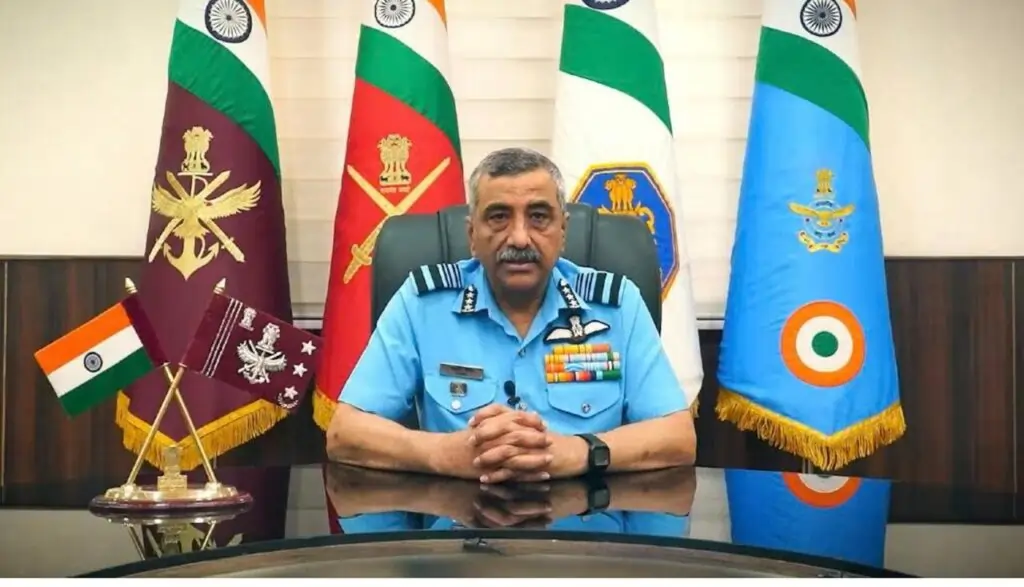
In a major leadership transition for the Indian Air Force, Air Marshal Ashutosh Dixit, PVSM, AVSM, VM, VSM — currently serving as Chief of Integrated Defence Staff (CISC) — has been appointed the next Vice Chief of the Air Staff (VCAS). He is scheduled to assume charge on July 1, 2026.
The appointment, announced by the Ministry of Defence and widely reported by other outlets, underscores the IAF’s emphasis on deep operational experience, indigenous modernisation, and tri-service integration at the highest levels. Air Marshal Dixit brings nearly four decades of distinguished service as a fighter pilot, experimental test pilot, and senior commander who has played pivotal roles in force modernisation and jointness.
Professional Profile and Career Trajectory
Air Marshal Ashutosh Dixit was commissioned into the fighter stream of the Indian Air Force on 6 December 1986. An alumnus of the National Defence Academy (Khadakwasla), Defence Services Staff College (Bangladesh), and National Defence College (New Delhi), he is a Qualified Flying Instructor and Experimental Test Pilot with over 3,300 hours of flying experience across more than 20 aircraft types, including the Mirage-2000, MiG-21, and Jaguar.
His career highlights include:
- Command of a premier Fighter Training Base in the Southern Sector, where the base was adjudged the best in the Command under his leadership.
- Service as Commanding Officer of the Flight Test Squadron at the Aircraft and Systems Testing Establishment (ASTE), Bengaluru, where he contributed significantly to indigenous avionics upgrade programmes for the Jaguar and MiG-27.
- Tenure as Director of Air Staff Requirements, during which he played a key role in the planning and conduct of the Medium Multi-Role Combat Aircraft (MMRCA) trials.
- Appointment as Air Officer Commanding-in-Chief, Central Air Command (1 September 2024 – 30 April 2025).
- Assumption of charge as Chief of Integrated Defence Staff on 1 May 2025, succeeding Lieutenant General Johnson P. Mathew, where he has been instrumental in advancing tri-service jointness and the move towards Theaterisation.
He has been conferred the Param Vishisht Seva Medal (PVSM), Ati Vishisht Seva Medal (AVSM), Vayu Sena Medal (VM), and Vishisht Seva Medal (VSM) for his distinguished service, particularly in indigenous development and operational leadership.
Strategic Significance of the Appointment
Air Marshal Dixit’s transition from the apex tri-service role of CISC to VCAS positions him ideally to drive IAF-specific modernisation while sustaining momentum on joint operations and integrated theatre commands. His extensive background in test flying, indigenous upgrades, and Air Staff Requirements aligns with the IAF’s current priorities of accelerating Atmanirbharata (self-reliance) in fighter aircraft, sensors, and weapons, alongside enhancing multi-domain operational capabilities.
India’s Evolving Battle Strategy: Lessons from Operation Sindoor to AI and Multi-Domain Warfare
Parallel to the leadership change, India’s defence establishment is actively shaping its future operational doctrine. A detailed analysis published by Outlook India examines how Operation Sindoor — the precision military response to the Pahalgam terror attack — has served as a live laboratory for next-generation warfare concepts.
Key takeaways include:
- Multi-Domain Integration: Operation Sindoor demonstrated seamless coordination across land, air, cyber, electronic warfare, and information domains, supported by real-time intelligence fusion through systems such as the Integrated Air Command and Control System (IACCS) and Akashteer.
- Drone and Unmanned Systems: The operation validated the effectiveness of robust air defence grids that neutralised incoming drone threats. India is now treating drones as “ammunition” — procuring them at scale for surveillance and strike roles while rapidly developing counter-drone capabilities (both soft-kill and hard-kill). Initiatives such as ‘Sudarshan Chakra’ aim to create comprehensive aerial defence architectures.
- AI-Enabled Decision Superiority: Artificial Intelligence is being embedded across sensors, networks, weapons, and planning processes to compress the Observe-Orient-Decide-Act (OODA) loop. Human oversight remains central to maintain accountability and ethical compliance.
- Self-Reliance and Industrial Resilience: The operation reinforced the strategic necessity of indigenous production and surge capacity. Major programmes — including orders for Light Combat Aircraft, Light Combat Helicopters, and trainer aircraft — are being accelerated alongside upgrades to legacy fleets.
- Integrated Theatre Commands: Building on the institutional framework established by the Chief of Defence Staff, India is moving towards Integrated Theatre Commands. A detailed report has been submitted to the Ministry of Defence, with implementation expected to follow structured organisational and training reforms.
The broader doctrinal shift marks a transition from purely reactive postures to proactive, technology-driven, precision-oriented operations that integrate conventional and irregular threats across multiple domains.
The appointment of Air Marshal Ashutosh Dixit as Vice Chief of the Air Staff, combined with the ongoing refinement of India’s multi-domain warfare doctrine, signals a deliberate strengthening of both leadership depth and operational capability within the Indian Air Force and the broader armed forces.
As the IAF prepares to assume a more pronounced role in joint theatre operations while advancing its indigenous fighter and unmanned platforms, Air Marshal Dixit’s unique blend of test-pilot expertise, operational command experience, and tri-service perspective is expected to prove invaluable.
These developments reflect India’s sustained commitment to building a future-ready military — one that is technologically advanced, self-reliant, and fully integrated across services.