



BY DEFENCE JOURNALIST SAHIL | T.I.N. NETWORK
बीकानेर से दिल्ली तक हाई अलर्ट: 10 हिंदू मंदिरों को उड़ाने की धमकी, RSS मुख्यालय भी निशाने पर! आखिर कौन है खालिस्तान नेशनल आर्मी? पाकिस्तान, अजरबैजान और डिजिटल टेरर नेटवर्क का पूरा खुलासा
भारत के खिलाफ नई साजिश या डिजिटल आतंक का नया अध्याय? मंदिरों, सरकारी इमारतों और राष्ट्रीय प्रतीकों को धमकी देकर क्या हासिल करना चाहते हैं खालिस्तानी नेटवर्क
नई दिल्ली
भारत की आंतरिक सुरक्षा के सामने एक बार फिर एक ऐसा खतरा उभरता दिखाई दे रहा है, जिसने सुरक्षा एजेंसियों, खुफिया तंत्र और राज्य सरकारों को एक साथ अलर्ट मोड पर ला दिया है। पिछले कुछ महीनों में देश के अलग-अलग हिस्सों से लगातार ऐसे ई-मेल सामने आए हैं जिनमें हिंदू मंदिरों, सरकारी कार्यालयों, रेलवे नेटवर्क, स्कूलों, विधानसभा परिसरों, मुख्यमंत्री कार्यालयों और राष्ट्रीय स्वयंसेवक संघ (RSS) के कार्यालयों को बम से उड़ाने की धमकियां दी गई हैं। इन सभी धमकियों की जिम्मेदारी एक नए नाम “खालिस्तान नेशनल आर्मी (KNA)” ने ली है।
सबसे अधिक चिंता की बात यह है कि इन धमकियों का दायरा केवल पंजाब तक सीमित नहीं है। जांच एजेंसियों के अनुसार दिल्ली, हरियाणा, गुजरात, महाराष्ट्र, पंजाब और राजस्थान तक फैले घटनाक्रम एक बड़े नेटवर्क की ओर इशारा करते हैं। राजस्थान के बीकानेर, श्रीगंगानगर और जोधपुर जैसे सामरिक रूप से संवेदनशील जिलों का नाम भी खालिस्तानी नेटवर्क के कथित दावों में सामने आने के बाद सुरक्षा एजेंसियों ने पश्चिमी सीमा से जुड़े क्षेत्रों पर विशेष निगरानी बढ़ा दी है।
4 जून को पंचकूला के मेयर को भेजे गए एक धमकी भरे ई-मेल ने पूरे मामले को राष्ट्रीय सुरक्षा का विषय बना दिया। इस ई-मेल में दिल्ली और हरियाणा के प्रमुख मंदिरों को निशाना बनाने की बात कही गई थी। संदेश में 1984 के ऑपरेशन ब्लू स्टार और जरनैल सिंह भिंडरांवाले की मौत का जिक्र करते हुए बदले की धमकी दी गई थी। ई-मेल मिलते ही कई राज्यों में सुरक्षा व्यवस्था को हाई अलर्ट पर डाल दिया गया।
बीकानेर क्यों बना राष्ट्रीय सुरक्षा चर्चा का केंद्र? राजस्थान की सीमाओं से जुड़ा बड़ा सवाल
राजस्थान का बीकानेर जिला सामान्य परिस्थितियों में पर्यटन, संस्कृति और सैन्य इतिहास के लिए जाना जाता है, लेकिन राष्ट्रीय सुरक्षा के नजरिए से यह क्षेत्र भारत के सबसे संवेदनशील इलाकों में गिना जाता है। पाकिस्तान सीमा के नजदीक स्थित यह क्षेत्र भारतीय सेना, सीमा सुरक्षा बल (BSF) और अन्य सुरक्षा एजेंसियों के लिए रणनीतिक दृष्टि से अत्यंत महत्वपूर्ण है।
बीकानेर, श्रीगंगानगर, अनूपगढ़ और पश्चिमी राजस्थान का पूरा इलाका लंबे समय से सीमा पार गतिविधियों पर नजर रखने का प्रमुख क्षेत्र रहा है। हाल के वर्षों में पाकिस्तान से ड्रोन के जरिए हथियार, नशीले पदार्थ और संचार उपकरण भेजे जाने के कई मामले सामने आ चुके हैं। ऐसे में जब खालिस्तान समर्थक संगठनों द्वारा जारी कथित नक्शों और बयानों में बीकानेर का नाम सामने आता है, तो सुरक्षा एजेंसियां इसे केवल प्रचार नहीं मानतीं बल्कि संभावित सुरक्षा चुनौती के रूप में देखती हैं।
विशेषज्ञों का कहना है कि बीकानेर केवल एक जिला नहीं बल्कि पश्चिमी भारत की सुरक्षा श्रृंखला का महत्वपूर्ण हिस्सा है। यहां किसी भी प्रकार की अस्थिरता पैदा करने की कोशिश का सीधा प्रभाव राष्ट्रीय सुरक्षा पर पड़ सकता है। यही कारण है कि हालिया धमकियों के बाद राजस्थान पुलिस, खुफिया एजेंसियों और केंद्रीय सुरक्षा संस्थानों ने पश्चिमी राजस्थान के संवेदनशील क्षेत्रों में निगरानी बढ़ा दी है।
खालिस्तान नेशनल आर्मी: एक संगठन नहीं बल्कि कई नेटवर्कों का नया गठजोड़?
सुरक्षा एजेंसियों के अनुसार खालिस्तान नेशनल आर्मी का नाम पहली बार बड़े पैमाने पर तब सामने आया जब जनवरी 2026 से लगातार विभिन्न सरकारी संस्थानों और धार्मिक स्थलों को धमकी भरे ई-मेल मिलने लगे। जांच में सामने आया कि ई-मेल अलग-अलग स्थानों से भेजे गए, लेकिन उनमें प्रयुक्त भाषा, शैली और दावे काफी हद तक एक जैसे थे।
सेवानिवृत्त सैन्य अधिकारियों और सुरक्षा विशेषज्ञों का मानना है कि KNA कोई पारंपरिक संगठन नहीं है। इसका कोई सार्वजनिक मुख्यालय, राजनीतिक विंग या घोषित नेतृत्व नहीं दिखाई देता। इसके बजाय यह कई पुराने खालिस्तानी संगठनों के सक्रिय और निष्क्रिय तत्वों का एक संयुक्त नेटवर्क प्रतीत होता है।
भारत लंबे समय से बब्बर खालसा इंटरनेशनल, खालिस्तान जिंदाबाद फोर्स, खालिस्तान टाइगर फोर्स और सिख फॉर जस्टिस जैसे संगठनों की गतिविधियों पर नजर रखता रहा है। पिछले कुछ वर्षों में अंतरराष्ट्रीय दबाव और भारत की कूटनीतिक सक्रियता के कारण इन संगठनों की खुली गतिविधियां सीमित हुई हैं। ऐसे में सुरक्षा विशेषज्ञों का मानना है कि नए नामों और नए मॉड्यूल्स के माध्यम से इन संगठनों ने अपनी गतिविधियों को पुनर्गठित करने की कोशिश की है।
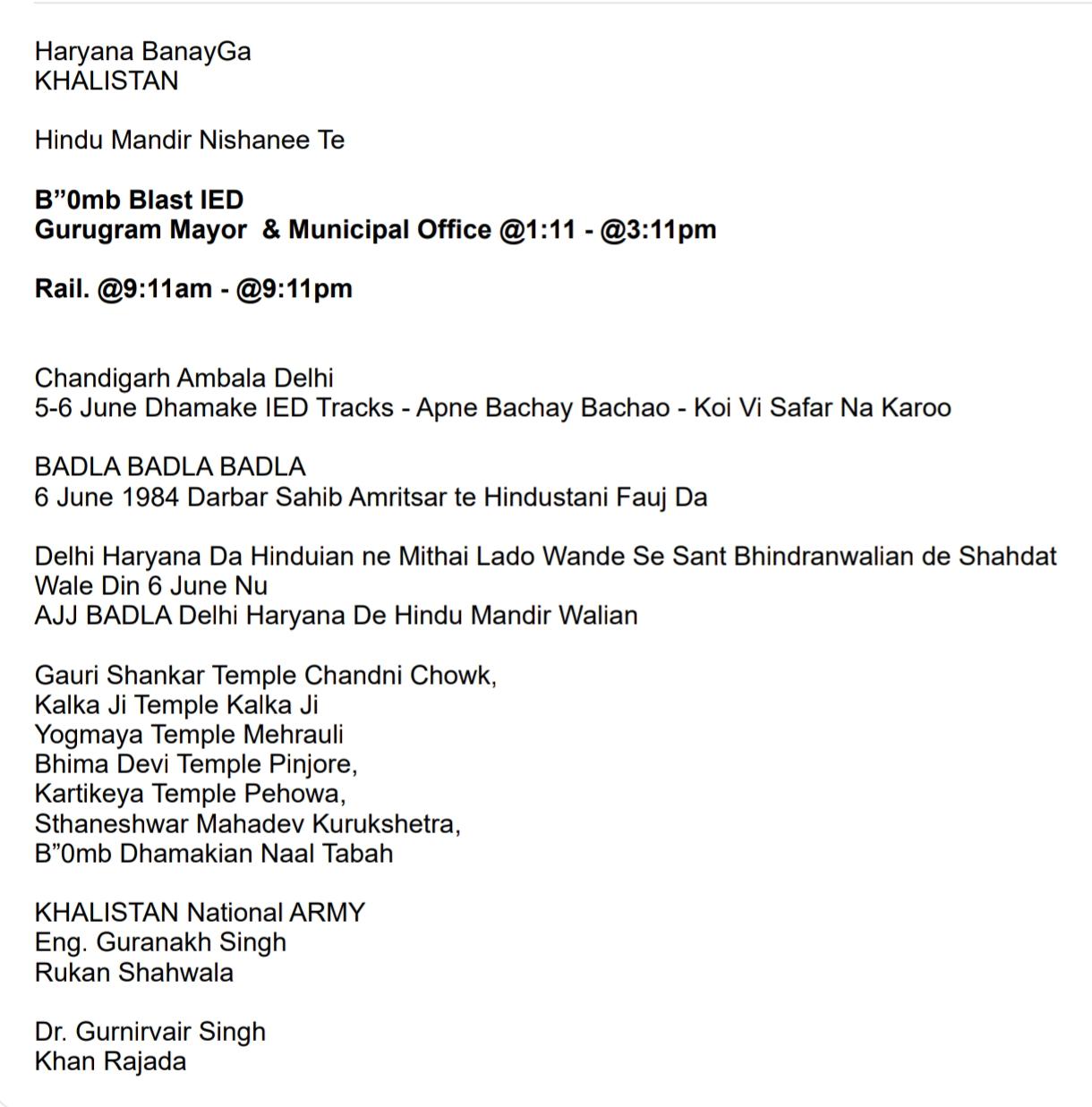
खालिस्तान नेशनल आर्मी की तरफ से ये भेजा गया था। इसमें लिखा है- हरियाणा बनेगा खालिस्तान। हिंदू मंदिर निशाने पर हैं। मेल में 6 मंदिरों के नाम भी लिखे हैं।
अजरबैजान कनेक्शन: क्या भारत विरोधी मंचों का नया केंद्र बन रहा है बाकू?
जनवरी 2026 में अजरबैजान की राजधानी बाकू में आयोजित एक सम्मेलन को लेकर भी सुरक्षा एजेंसियों की दिलचस्पी बढ़ गई है। विभिन्न रिपोर्टों के अनुसार इस सम्मेलन में पाकिस्तान, कनाडा और अमेरिका में सक्रिय भारत विरोधी तत्वों ने भाग लिया था।
खुफिया सूत्रों का मानना है कि इस सम्मेलन में केवल राजनीतिक चर्चा नहीं हुई, बल्कि भारत विरोधी गतिविधियों के विभिन्न पहलुओं पर भी विचार किया गया हो सकता है। हालांकि इसकी आधिकारिक पुष्टि अभी तक नहीं हुई है, लेकिन सम्मेलन के कुछ दिनों बाद भारत में धमकी भरे ई-मेल्स की श्रृंखला शुरू होना जांच एजेंसियों के लिए महत्वपूर्ण संकेत माना जा रहा है।
विशेषज्ञ बताते हैं कि दक्षिण काकेशस क्षेत्र में बदलते भू-राजनीतिक समीकरण भी इस मामले को और संवेदनशील बना देते हैं। भारत और आर्मेनिया के बीच बढ़ता रक्षा सहयोग तथा पाकिस्तान और अजरबैजान के बीच मजबूत होते संबंध क्षेत्रीय राजनीति को नया आयाम दे रहे हैं। इसी पृष्ठभूमि में भारत विरोधी तत्वों की गतिविधियों को देखा जा रहा है।

ये अजरबैजान में खालिस्तान समर्थकों के सम्मेलन की फोटो है। इसका विषय था- भारत में सिखों और अल्पसंख्यकों के खिलाफ नस्लवाद और हिंसा।
पाकिस्तान की भूमिका पर फिर उठे सवाल, ISI का पुराना मॉडल नए रूप में?
भारत की सुरक्षा एजेंसियां लंबे समय से यह मानती रही हैं कि पाकिस्तान की खुफिया एजेंसी ISI विभिन्न भारत विरोधी संगठनों को समर्थन देती रही है। चाहे वह सीमा पार आतंकवाद हो, सोशल मीडिया प्रचार हो या साइबर गतिविधियां, कई मामलों में पाकिस्तान स्थित नेटवर्कों के लिंक सामने आए हैं।
खालिस्तान से जुड़े कई वांछित तत्व वर्षों से पाकिस्तान में मौजूद बताए जाते रहे हैं। भारतीय एजेंसियों का आरोप है कि इन्हें प्रशिक्षण, वित्तीय सहायता और सुरक्षित ठिकाने उपलब्ध कराए जाते हैं। हालांकि पाकिस्तान इन आरोपों को खारिज करता रहा है।
विशेषज्ञों के अनुसार अब आतंकवाद का स्वरूप बदल चुका है। पहले हथियार और घुसपैठ प्राथमिक साधन थे, लेकिन अब साइबर स्पेस, सोशल मीडिया, ई-मेल और एन्क्रिप्टेड कम्युनिकेशन प्लेटफॉर्म आतंकवादी नेटवर्कों के लिए नए हथियार बन गए हैं। इससे बिना सीमा पार किए भी बड़े पैमाने पर मनोवैज्ञानिक दबाव बनाया जा सकता है।

मंदिर क्यों बने निशाना? धार्मिक ध्रुवीकरण और सामाजिक तनाव फैलाने की कोशिश
सुरक्षा विशेषज्ञों का मानना है कि मंदिरों को निशाना बनाने की धमकियों का उद्देश्य केवल किसी इमारत को नुकसान पहुंचाना नहीं है। इसके पीछे व्यापक सामाजिक और मनोवैज्ञानिक प्रभाव पैदा करने की रणनीति हो सकती है।
भारत जैसे विविधतापूर्ण देश में धार्मिक स्थलों पर हमला या उसकी धमकी तुरंत राष्ट्रीय स्तर पर चिंता और तनाव का कारण बनती है। आतंकवादी संगठन अक्सर इसी मनोवैज्ञानिक प्रभाव का फायदा उठाने की कोशिश करते हैं। यदि किसी मंदिर, गुरुद्वारे, मस्जिद या चर्च को निशाना बनाने की खबर फैलती है तो उसका असर केवल स्थानीय स्तर तक सीमित नहीं रहता बल्कि पूरे देश में महसूस किया जाता है।
विशेषज्ञों का मानना है कि धमकियों का उद्देश्य लोगों में भय पैदा करना, सुरक्षा एजेंसियों पर दबाव बनाना और समाज में अविश्वास का माहौल तैयार करना भी हो सकता है।
RSS मुख्यालय, CM ऑफिस और सरकारी संस्थान भी रडार पर
हालिया धमकियों में केवल धार्मिक स्थल ही नहीं बल्कि राष्ट्रीय स्वयंसेवक संघ के कार्यालय, मुख्यमंत्री कार्यालय, नगर निगम भवन, सचिवालय और रेलवे नेटवर्क भी शामिल रहे हैं।
गुजरात में मुख्यमंत्री कार्यालय और अहमदाबाद नगर निगम को भेजी गई धमकियों ने यह संकेत दिया कि निशाने केवल धार्मिक स्थल नहीं बल्कि प्रशासनिक और वैचारिक प्रतीक भी हो सकते हैं। इसके बाद कई राज्यों में सुरक्षा व्यवस्था की समीक्षा की गई और संवेदनशील संस्थानों की सुरक्षा को और मजबूत किया गया।
डिजिटल आतंकवाद का नया मॉडल: बिना गोली चलाए पूरे देश को अलर्ट पर लाना
पूर्व पुलिस अधिकारियों का कहना है कि ई-मेल आधारित धमकियां आतंकवाद की नई रणनीति का हिस्सा हैं। पहले जहां आतंकवादी संगठन पोस्टर, पर्चे या वीडियो संदेशों का उपयोग करते थे, वहीं अब इंटरनेट के जरिए हजारों किलोमीटर दूर बैठकर पूरे देश को अलर्ट पर डाला जा सकता है।
एक धमकी भरा ई-मेल भेजने की लागत बेहद कम होती है, लेकिन उसका प्रभाव बहुत बड़ा हो सकता है। सुरक्षा एजेंसियों को तत्काल कार्रवाई करनी पड़ती है, बम निरोधक दस्ते तैनात किए जाते हैं, सार्वजनिक स्थानों को खाली कराया जाता है और आम लोगों में चिंता फैल जाती है।
यही कारण है कि सुरक्षा विशेषज्ञ इसे “डिजिटल टेररिज्म” का नया रूप मानते हैं।
राजस्थान, बीकानेर और सीमावर्ती जिलों में बढ़ी निगरानी
राजस्थान के बीकानेर, श्रीगंगानगर, अनूपगढ़ और जैसलमेर जैसे जिलों में पहले से ही सुरक्षा एजेंसियों की विशेष निगरानी रहती है। हालिया घटनाओं के बाद स्थानीय पुलिस, खुफिया इकाइयों और केंद्रीय एजेंसियों के बीच समन्वय को और मजबूत किया गया है।
सीमावर्ती गांवों, धार्मिक स्थलों, रेलवे नेटवर्क, सार्वजनिक आयोजनों और संवेदनशील सरकारी परिसरों पर निगरानी बढ़ाई गई है। ड्रोन गतिविधियों और साइबर संचार पर भी विशेष नजर रखी जा रही है।
बीकानेर से दिल्ली तक सुरक्षा की नई चुनौती, बदलते आतंकवाद के खिलाफ बदलनी होगी रणनीति
खालिस्तान नेशनल आर्मी का नाम सामने आने के बाद एक बात स्पष्ट हो गई है कि भारत विरोधी नेटवर्क अब केवल पारंपरिक आतंकवादी तरीकों पर निर्भर नहीं हैं। वे साइबर स्पेस, डिजिटल प्रचार, अंतरराष्ट्रीय मंचों और मनोवैज्ञानिक युद्ध के जरिए भी अपने उद्देश्य हासिल करने की कोशिश कर रहे हैं।
बीकानेर से लेकर दिल्ली तक, मंदिरों से लेकर सरकारी भवनों तक और सोशल मीडिया से लेकर अंतरराष्ट्रीय मंचों तक फैला यह घटनाक्रम राष्ट्रीय सुरक्षा के बदलते स्वरूप की ओर संकेत करता है। भारत की सुरक्षा एजेंसियों के सामने चुनौती केवल संभावित हमलों को रोकने की नहीं है, बल्कि उन नेटवर्कों की पहचान करने की भी है जो डिजिटल माध्यमों से भय और अस्थिरता फैलाने की कोशिश कर रहे हैं।
आज जब देश की सीमाओं पर सेना सतर्क है, तब साइबर और मनोवैज्ञानिक मोर्चों पर भी उतनी ही सजगता की आवश्यकता है। क्योंकि आधुनिक दौर में युद्ध केवल सीमा पर नहीं, बल्कि ई-मेल, सर्वर, सोशल मीडिया प्लेटफॉर्म और डिजिटल नेटवर्क के माध्यम से भी लड़ा जा रहा है।
BY DEFENCE JOURNALIST SAHIL | T.I.N. NETWORK
BIKANER TO DELHI ON HIGH ALERT: INSIDE THE KHALISTAN NATIONAL ARMY, THE THREATS AGAINST HINDU TEMPLES, AND THE GROWING PAKISTAN-AZERBAIJAN CONNECTION
Ten Temples, Government Buildings, RSS Headquarters and Critical Infrastructure Reportedly Targeted as Security Agencies Investigate a New Pattern of Digital Threats Across India
A New Security Challenge Emerges
India’s security establishment is confronting a rapidly evolving threat landscape in which traditional methods of terrorism are increasingly being combined with digital intimidation, psychological warfare, and transnational extremist networking. Over the past several months, a series of bomb threats sent through emails have triggered nationwide concern, forcing security agencies to launch extensive investigations and emergency security operations across multiple states.
The threats, allegedly issued in the name of a group calling itself the Khalistan National Army (KNA), have targeted Hindu temples, government offices, educational institutions, railway infrastructure, municipal corporations, and even ideological and political organizations. Although most of the threats have not resulted in the discovery of explosive devices, security experts warn that the larger objective may be to create fear, stretch security resources, test response mechanisms, and project the illusion of a widespread underground network.
What makes the situation particularly alarming is the geographical spread of the threats. From Delhi and Haryana to Gujarat, Punjab, Maharashtra, and Rajasthan, the pattern suggests an attempt to create a national-level security concern rather than a localized disturbance. For intelligence agencies, the issue is no longer limited to individual emails; it is about understanding whether these threats are part of a broader strategy being coordinated beyond India’s borders.
Why Bikaner and Rajasthan Have Suddenly Become Part of the Security Conversation
The inclusion of Rajasthan, particularly Bikaner, in discussions surrounding alleged Khalistani networks has drawn significant attention within strategic and security circles. Bikaner occupies a unique place in India’s security architecture. Located in western Rajasthan and positioned relatively close to the international border with Pakistan, the district serves as an important military and logistical hub.
For decades, Bikaner, Sri Ganganagar, Anupgarh, and adjoining regions have been critical sectors for border management, military deployment, and surveillance operations. The area has witnessed increased monitoring in recent years due to concerns over cross-border smuggling, drone activity, narcotics trafficking, and attempts to move illegal communication equipment into India.
Security analysts argue that any extremist narrative attempting to establish influence in western Rajasthan should be viewed through a broader strategic lens. Unlike urban centers where threats primarily affect civilian populations, disturbances in border states can potentially intersect with national security concerns. The mention of districts such as Bikaner and Sri Ganganagar in extremist propaganda and network claims has therefore attracted considerable scrutiny from intelligence agencies.
Several retired military officers have pointed out that western Rajasthan has gained strategic significance following changing security dynamics along India’s western frontier. Any effort by extremist groups to establish influence, recruit sympathizers, spread propaganda, or create fear in this region would be treated as a matter of serious concern.
The Temple Threat Emails That Triggered a National Security Response
The issue came into sharper focus when threatening emails warning of attacks on major Hindu temples were reportedly received by public officials. The messages referred to historical grievances linked to Operation Blue Star and the death of Jarnail Singh Bhindranwale in 1984.
The language used in these communications was intended to generate fear and urgency. Authorities immediately launched security sweeps at religious locations, deployed bomb disposal squads, activated dog squads, and increased surveillance around major places of worship. While no explosive devices were ultimately found during these operations, the threats were treated seriously due to the potential consequences of ignoring them.
Security officials note that modern terrorism increasingly relies on psychological impact. An attack does not necessarily need to occur for fear to spread. A single credible threat can force authorities to mobilize hundreds of personnel, disrupt public activities, and generate widespread anxiety among citizens.
This phenomenon has become an important aspect of contemporary security challenges worldwide. Threats themselves can become weapons when they succeed in creating uncertainty and fear.
Who Is the Khalistan National Army?
One of the most significant questions facing investigators is the true nature of the Khalistan National Army. Unlike traditional militant organizations that possess visible leadership structures, public messaging channels, and identifiable command hierarchies, the KNA appears far more ambiguous.
According to several security analysts, the organization may not be a conventional group at all. Instead, it could represent a coalition, operational label, or digital umbrella under which individuals associated with different extremist networks operate. Such structures are increasingly common in modern extremist ecosystems, where decentralized actors coordinate online while maintaining limited physical footprints.
Experts studying Khalistani extremism believe the emergence of newer names and formations may reflect efforts to rebrand existing networks after increased scrutiny by international governments. Over the years, several organizations advocating separatist agendas have faced legal action, surveillance, and diplomatic pressure. Creating new identities allows networks to adapt while maintaining operational continuity.
Whether KNA represents an entirely new organization or a reconfiguration of existing extremist elements remains a subject of ongoing investigation.
The Pakistan Dimension: Longstanding Concerns and Renewed Questions
For decades, Indian security agencies have expressed concerns regarding alleged support provided by Pakistan-based elements to anti-India extremist groups. While Islamabad has consistently rejected such allegations, intelligence assessments in India have frequently linked various militant networks to infrastructure, safe havens, or facilitators operating across the border.
The emergence of KNA has once again revived these discussions.
Security experts argue that Pakistan’s intelligence environment and historical involvement with proxy actors make it a recurring focus whenever new extremist structures emerge. Investigators are examining whether digital communications, propaganda efforts, and threat campaigns have any operational links to networks based in Pakistan.
Retired intelligence officers emphasize that modern proxy warfare has evolved significantly. Unlike earlier periods dominated by physical infiltration, contemporary operations increasingly involve cyber activity, digital propaganda, encrypted communications, and psychological operations designed to influence public perception.
In such an environment, identifying the real origin of threats becomes considerably more challenging.
Azerbaijan’s Unexpected Appearance in the Story
Perhaps the most intriguing aspect of recent discussions has been the alleged connection between anti-India extremist elements and meetings reportedly held in Azerbaijan.
The South Caucasus nation has become strategically important due to its growing regional influence and partnerships with countries including Pakistan and Türkiye. At the same time, India has expanded defense cooperation with Armenia, Azerbaijan’s principal regional rival.
Security observers note that geopolitical rivalries often create opportunities for non-state actors seeking political support, visibility, or operational space. Reports regarding meetings involving extremist figures in Baku have therefore attracted attention within India’s security community.
While definitive evidence regarding operational planning remains subject to investigation, analysts believe that any platform bringing together anti-India actors from multiple countries deserves careful examination. The convergence of ideological, political, and strategic interests can sometimes create environments where extremist narratives gain momentum.
The Azerbaijan angle also highlights the increasingly international nature of security threats facing India. Activities that may eventually affect domestic security can originate thousands of kilometers away through networks spanning multiple continents.
Digital Terrorism: The New Battlefield
One of the most striking features of the current situation is the reliance on digital communication.
Former police and intelligence officials describe the wave of threatening emails as part of a broader transformation in extremist tactics. In previous decades, organizations relied on posters, pamphlets, cassette recordings, underground publications, and physical propaganda campaigns. Today, encrypted messaging platforms, anonymous email services, virtual private networks, and social media networks have fundamentally altered the operating environment.
A single email can trigger large-scale security responses across multiple states. Airports, temples, railway stations, schools, and government buildings may all require immediate inspection. Thousands of personnel can be mobilized within hours.
This asymmetry benefits threat actors. The cost of sending a threatening message is negligible, while the cost of responding can be substantial.
Cybersecurity specialists increasingly describe such tactics as a form of psychological warfare. Even when no attack occurs, the disruption itself can serve the objectives of those seeking attention, publicity, or fear.
Why Religious Sites Remain High-Value Targets
Religious places occupy a special position in India’s social fabric. Temples, mosques, churches, gurudwaras, and other places of worship are not merely buildings; they are symbols of identity, faith, history, and community.
Security experts argue that threats against religious sites are often intended to maximize psychological impact. An attack—or even the threat of an attack—can generate intense media attention, public anxiety, and social tension.
For extremist organizations seeking visibility, religious sites unfortunately represent attractive symbolic targets. Threats directed at such locations can quickly resonate far beyond the immediate geographic area.
This explains why authorities consistently treat threats against religious institutions with the highest level of seriousness, regardless of whether the source initially appears credible.
RSS Headquarters, Government Offices, and Public Infrastructure Also Reportedly Under Threat
The pattern of threats extends beyond religious locations. Reports indicate that various government facilities, municipal offices, administrative complexes, and ideological institutions have also been named in threatening communications.
Security analysts believe this broader target selection may reflect an effort to project capability and relevance. By claiming responsibility for threats against a wide range of locations, extremist actors attempt to create the impression of extensive reach and operational flexibility.
Such tactics are often designed to magnify perceived influence far beyond actual capabilities.
Authorities have therefore adopted a cautious approach, investigating each threat individually while simultaneously analyzing larger patterns that may reveal common origins or coordination mechanisms.
The Seven-State Network Claim and Security Concerns in Northern India
Claims regarding the presence of support networks across multiple northern Indian states have generated additional concern. While such claims require careful verification, they nevertheless influence security planning and intelligence assessments.
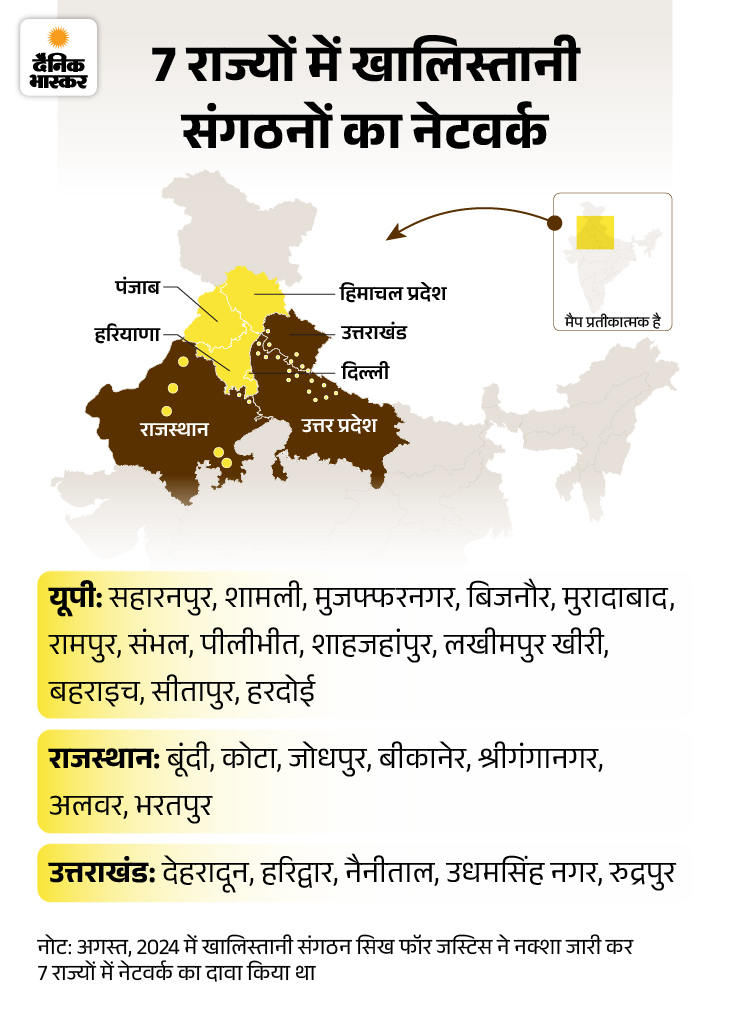
States frequently mentioned in discussions include Punjab, Haryana, Delhi, Rajasthan, Uttar Pradesh, Uttarakhand, and Himachal Pradesh. Within Rajasthan, districts such as Bikaner, Sri Ganganagar, Jodhpur, Alwar, Bharatpur, Kota, and Bundi have drawn attention due to their strategic locations or demographic significance.
Security agencies continue to monitor potential recruitment efforts, propaganda dissemination, financial channels, and digital communication networks that may facilitate extremist activity.
The challenge is complicated by the fact that modern extremist ecosystems often operate across both physical and virtual domains simultaneously.
Bikaner’s Strategic Importance in India’s Security Architecture
For readers outside Rajasthan, understanding Bikaner’s significance is essential.
Bikaner sits within one of India’s most strategically important regions. The district lies close to sensitive border sectors and has historically played a major role in military logistics, troop movement, training activities, and national defense preparedness.
The broader western Rajasthan region has become increasingly important in recent years due to evolving regional security dynamics. Military exercises, infrastructure development, border management initiatives, and surveillance modernization programs have all contributed to the area’s growing strategic profile.
Consequently, any attempt by extremist groups to associate themselves with the region attracts immediate attention from both state and national security institutions.
A New Era of Hybrid Threats
The emergence of the Khalistan National Army narrative represents more than a series of threatening emails. It reflects the changing nature of security challenges in the twenty-first century.
Today’s threats are hybrid in nature. They combine digital communication, psychological warfare, transnational networking, geopolitical rivalries, ideological extremism, and information operations. They blur traditional distinctions between domestic and international security.
From Delhi to Bikaner, from temples to government offices, and from cyberspace to border regions, the challenge facing Indian security agencies is increasingly complex. The objective is no longer simply preventing physical attacks; it is also understanding and countering the networks, narratives, and technologies that enable modern extremist activity.
As investigations continue, one reality is becoming increasingly clear: future security threats may not always arrive through physical infiltration or visible militant movements. They may begin with a message, an email, a digital network, or an online campaign capable of influencing events across an entire nation.
In this evolving environment, intelligence coordination, cybersecurity preparedness, public vigilance, and strategic foresight will remain India’s most powerful tools in confronting emerging threats and protecting national security.